The Warning Signs Your AC Gives You Before It Quits
Most air conditioners don't die without warning, they just don't warn you loudly enough to notice on your own.
August 27, 2026 · 4 min read
The Timing Isn't Bad Luck
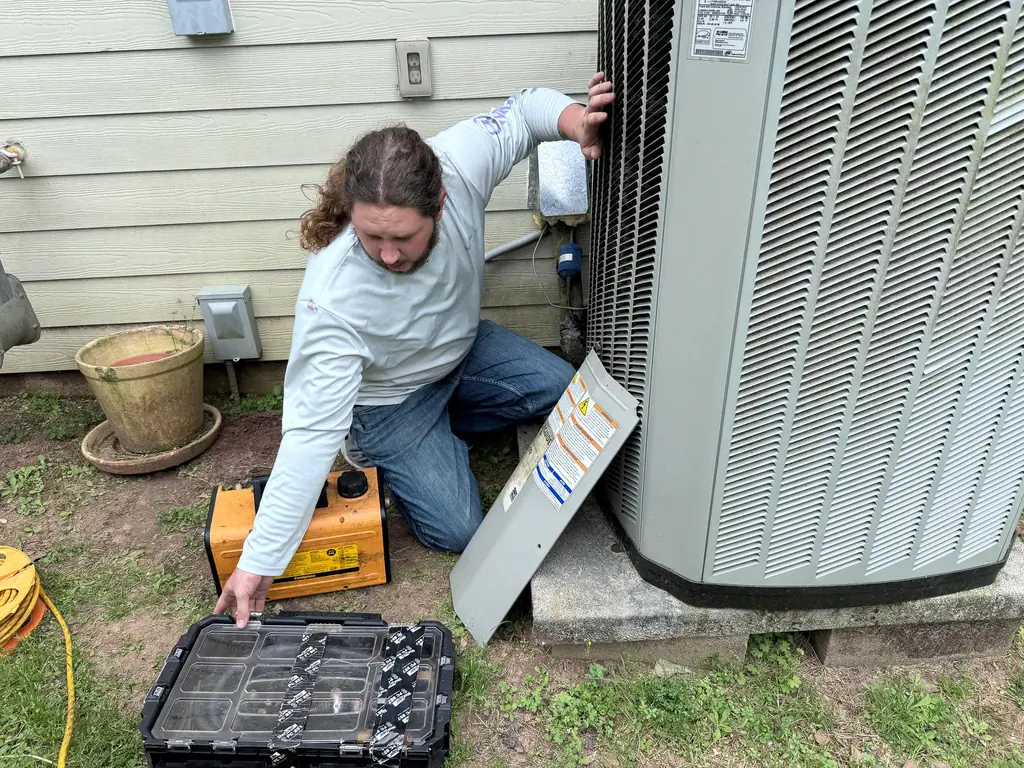
There's a reason an AC system seems to wait for the worst possible week to break. It isn't cruelty, it's physics. A compressor that limped along fine in April, cycling on and off with plenty of rest between runs, gets asked to work nearly nonstop once outdoor temperatures push past 95 degrees for days in a row. Any component that was already marginal, a weak capacitor, a slightly low refrigerant charge, a coil coated in a season of dust, gets pushed past the point it can compensate for. The failure isn't sudden. The strain that caused it has just finally caught up with the part that could least handle it.
Short Cycling Is the First Whisper
Short cycling is when your system turns on, runs for a few minutes, shuts off, then starts again shortly after, rather than running a full, steady cycle. It's one of the clearest early signs something is wrong, and also one of the easiest to miss, because the house still feels cool. A unit that's short cycling might be oversized for the space, have a refrigerant charge that's drifted low, have a failing capacitor that can't sustain the compressor's start, or have a thermostat sensor reading the room wrong. Whatever the cause, every short cycle adds wear to the compressor's start components, the parts most expensive to replace and least likely to be sitting on a truck for a same-day fix in the middle of July.
Airflow That's Just Off
Before a system fails outright, it usually gets worse at moving air first. A bedroom that used to cool down fine now lags behind the rest of the house. Vents that used to blow hard now feel lazy. This can be as simple as a filter that's overdue, or something more serious: a blower motor losing strength, a duct that's come loose in the attic and is dumping cooled air where nobody lives, or refrigerant low enough that the evaporator coil is icing over and choking its own airflow. The fix ranges from a five-dollar filter to a service call, but the pattern is the same either way. Weak or uneven airflow rarely stays a minor problem for long.
Ice Where There Shouldn't Be Any
A coil or line set with a layer of frost on it in the middle of summer looks almost backwards, ice showing up on a system that's supposed to be pulling heat out of the house rather than making anything cold to the touch. It usually means airflow across the evaporator coil has dropped low enough, from a dirty filter, closed vents, or a struggling blower, that the coil temperature drops below freezing and moisture from the air starts collecting on it as ice instead of draining away as condensation. Once that ice builds up, it blocks even more airflow, which makes the problem worse in a feedback loop that can end with a compressor trying to pump refrigerant through a partially frozen system. Turning the unit off and letting it thaw buys a little time. It doesn't fix whatever caused the freeze in the first place.
Sounds and Smells Worth Stopping For
- A clicking that continues after startup, not just once at power-on. Often a failing relay or capacitor.
- A hissing or bubbling near the indoor unit. Usually points to a refrigerant leak.
- A grinding or squealing from the outdoor unit. Often a motor bearing wearing out.
- A musty smell when the system first kicks on. Typically standing water or growth in the drain pan or ductwork.
- A burning or electrical smell of any kind. Shut the system off and get someone out the same day.
What a Rising Electric Bill Is Actually Telling You
If your electric bill has crept up over the past couple of summers without a matching jump in electricity rates or hours spent home, your system is very likely working harder to do the same job. Dirty condenser coils outside make the unit reject heat less efficiently. A dirty evaporator coil inside does the same in reverse. Low refrigerant makes the compressor run longer to hit the same setpoint. None of these show up as a dramatic failure. They show up as a number on a bill that keeps drifting the wrong direction, and by the time it's obvious, the system has usually been under strain for months already.
Catching It Before the Compressor Goes
Most of these signs show up weeks before an actual breakdown, which is the whole point of paying attention to them instead of waiting for the day the house stops cooling. A technician who's actually licensed on your type of system, not guessing, can usually spot a struggling capacitor or a slow refrigerant leak on a routine visit long before it turns into an emergency call in August. Air Monkey's technicians have been doing exactly that kind of early-catch work across Tomball and the surrounding towns since 2015, mostly because a five-minute fix in June beats a no-cool call in July every time.
Air Monkey Air Conditioning & Heating, 281-758-8200
Call 281-758-8200More articles
What Actually Happens When a Tech Services Your AC
A real maintenance visit is closer to a full physical for the system than a filter swap with an invoice attached.
The Ductwork Problem Hiding in Your Attic
A system with a healthy compressor and bad ductwork can still leave rooms uneven and bills high, and the equipment gets blamed for it every time.